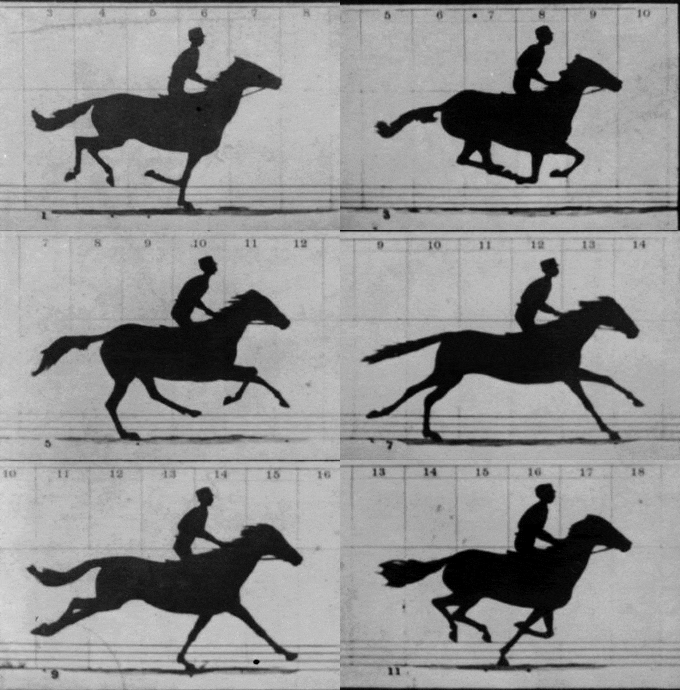
Before George Lucas, before Charlie Chaplin, before this horse moving about 10 frames-per-second blew everyone’s mind, death wasn’t something we watched on demand from the comfort of our couches.
Eadweard Muybridge, The Horse in Motion (1878)
It was performed, sure. But we couldn’t binge it. Shakespearean knifings and poisonings hadn’t scaled to global audiences yet, and staged demises looked like paper cuts compared to what 21st century movies wrought.
At the turn of the 20th century, death was mostly something seen in life, not art: a plagued body strewn in the street. Your aging grandmother down the hall. Your own offspring. Born just as infectious diseases and waterborne pathogens were being tamed, the movie industry inverted our exposure to real and fantastical deaths. As real deaths fell, screen deaths rose.
Real deaths fell. Screen deaths rose.
Data
Top: period life expectancy at birth in the Americas, from sparse historical estimates (dots) to annual figures after 1950. Bottom: 1980–2021, each on its own scale — life expectancy in Northern America; movie tickets sold in the U.S. and Canada; and on-screen deaths Cinemorgue fans have catalogued, by the film’s release year. The bottom panels rise together over the decades, but not year to year: two long trends, not cause and effect. Ticket sales peaked in 2002 and were lower by 2019, before the 2020 collapse; catalogued deaths peaked in 2014. Cinemorgue counts reflect what fans have logged, not every death ever filmed, and the newest years may still be filling in.
Sources: Our World in Data (Riley 2005; Zijdeman et al. 2015; HMD 2025; UN WPP 2024); Statista, citing Variety; Cinemorgue, entries tagged Film.
Sometimes our iconic on-screen killers are heroes. Sometimes they’re villains. Often they’re something in between. But regardless of which way their moral compass tilts, they’re there to sate our bloodlust.
And they can’t do it without bodies to burn through — bodies often belonging to extras who are undercredited and overconcussed.
By synthesizing data from 60,000 on-screen film deaths, plus perspectives from a professor of entertainment labor and one of Hollywood’s most prolific victims, GraveSite found that killing — and dying — onscreen is big business for a privileged few, while those who put their actual bodies on the line for our viewing pleasure are also the likeliest to be erased from the narrative altogether.
Eric Roberts: “Death is so thankless.”
“I’ve died maybe every way there is to die. I’ve died by gun, by suicide, by a murder, by hanging, by jumping off buildings.”
The archetypes
Data
To understand who kills, who dies, and who gets the credit (credit counts if the performer is among a film’s top 10 principal actors per IMDb), we’ll explore four archetypes:
Apex Predators kill much more often than they die, and they are top-billed in more films than either.
Popular Prey die more often than they kill. Their top-billed credit lists run longer than both.
The Dying Cast almost never kill. Death takes up at least half of a much shorter credit list.
The Uncredited Dead are deaths the top-billed list does not record, but contributors to Cinemorgue do.
Kills, deaths, and credits share one scale. The track ends at the largest median in the chart. A fourth bar is deaths per credit, with the full track as 100%. Apex Predators: 54 kills, 18 deaths, 90 top-billed credits, 20% deaths per credit. Popular Prey: 10 kills, 30 deaths, 107 credits, 28%. The Dying Cast: 1 kill, 9 deaths, 14 credits, 64%. The Uncredited Dead: 0 kills, 4 deaths, 0 credits, shown at 100% because deaths meet or exceed credits.
Data
An animated graphic that follows the same set of actors through five views:
a network of Hollywood’s most prolific on-screen killers and their victims,
a predators-versus-prey comparison of kills and deaths, a tally of the actors
who die most often, those deaths spread across each actor’s career, and the
share of each actor’s top-billed films that end in their on-screen death.
The last of those views colors the Dying Cast purple. A dashed ring marks stunt performers when that step, or the Stunt Performer control, asks for them.
Every figure shown is also available in the data table in the methodology section.
The Apex Predators: One in 10 killers does nearly half the killing.
— star of action features like Hard to Kill, Marked for Death, and Half Past Dead — is, by any legal definition, a homicidal maniac. Well, his characters are, at least.
The 7th-dan black belt is part of an elite group of apex murderers. According to Cinemorgue Wiki, an online encyclopedia of onscreen deaths, the top 1% of killers deliver 13.2% of all attributed kills, and the top 10% deliver nearly half (45.6%).
At the top sit the invincible-hero leads, the men (yes, shocker, they’re all men) who out-muscle goons by the dozen; actors like and have ended 106 and 89 characters’ lives, respectively.
It’s not a competition, but given the hyper-masculine nature of this stuff, let’s make it one!
Among the top killers (by total kills), people like , , and Jimmy Wang Yu reached the apex with fewer film credits than the likes of , , and .
The Popular Prey: some actors become stars by dying well and often.
Of course, not everyone gets to be the shark. Line actors up by how often they kill and how often they die, and Hollywood splits into predators and prey.
Some actors are so good at playing characters who meet their maker that they’ve been asked to do it again and again.
In fact, top-victims and began their careers trying to kill each other.
— father to Emma, brother to Julia, and a living legend in his own right — is a born performer. Almost literally. He was on stage at four years old and acted his first death at eight.
Roberts’ star rose quickly. He received a Golden Globe nomination for 1978’s King of the Gypsies (in which, spoiler, his character lives) and another for Bob Fosse’s 1983 directorial exit: Star 80 (in which, super spoiler, his character Paul Snider murders a Playboy Bunny and then takes a shotgun to his own chin).
He received his sole Academy Award nom (Supporting Actor) to date for his performance alongside Jon Voight in 1985’s Runaway Train. During the production, famed author and the film’s co-writer, Eddie Bunker, had Roberts go pick out a scene partner from a lineup of actors dressed as inmates. They wore fake tattoos and did their best to look tough. But one of them was an actual former inmate with very real tattoos. And that’s who Roberts chose (after a little coaxing from Bunker). It was .
was imprisoned at San Quentin State Prison in California from 1966 to 1969. While there, two things happened. First, he met the youngest inmate in San Quentin — a 17-year-old named Eddie Bunker (prison kismet!) who was in because he stabbed a guard at a different facility. Second, he became a boxing champion in the prison’s lightweight and welterweight divisions.
Eric, entering a peak in his career, met Danny, whose career was just getting off the ground, in a boxing ring on the set of Runaway Train. In the film, Eric’s character won the fight. But in the acting arena, the war over onscreen body count is ongoing.
Eric Roberts on meeting Danny Trejo.
“I’ve been beat up a few times in my life, but I would never fight Danny Trejo. Danny Trejo’s the real deal. He’s a real fighter.”
For every 10 top-billed films these old pals make, Roberts will die in one and Trejo will die in about four.
Dying is not a bad way to make a living, Roberts told GraveSite:
“I mean to have that job and to make your living doing that, what fun! And I highly recommend it, by the way.”
But a big body count can be a mirage. Stretch each actor’s deaths across the years they’ve been working and the pile, for many, looks different. This indicates some of these prolific performers of death are simply prolific performers, period.
Take Mr. Roberts. Fifty-four film deaths across a 50-year career is about one a year. Meanwhile he has earned .
And he wouldn’t have it any other way:
“The way I look at it is that I’m one of the luckiest guys in Hollywood. We get anywhere from eight to 30 offers every single day from all over the world. It’s just so much fun to have all these offers and get to play such an extreme range of characters. … I probably work around 200 days a year. And I have never been happier.”
“You don’t say, ‘Get out of my way,’ to Danny Trejo. You say, ‘Excuse me.’ … Danny is a teddy bear.”
Today, they’re friends. But back then, by Eric’s account, he was scared. And corroborated it:
“[Eddie Bunker asked] ‘Do you want a job? We need someone to train one of the actors how to box… It pays $320 a day.’ So I said, ‘How bad do you want this guy beat up? Shit, for 320 bucks.’ And he goes, ‘No, you have to be really careful, this actor’s really high-strung. He’s already socked a couple of people.’ I said, ‘For $320, man, give him a stick. I’ll fight Godzilla for 320 bucks.’ I started training Eric Roberts how to box. Eric wanted to learn how to box, and I think he was scared of me, so he’d do whatever I told him to do. Andrei Konchalovsky, the director, saw that he would do whatever I told him to do. So Andrei comes over and hires me. He says, ‘You be in the movie. You fight Eric in the movie.’ And that’s where it started.”
and are two guys who die a lot, but they work even more. It’s a volume thing. They’re cast for their proven ability to die, sure. But Trejo’s mean mug and Roberts’ pretty one make them acting generalists, not dying specialists.
There is a class of actors, however — 199 of them, according to the data — who get far fewer opportunities but perish at much higher rates: each has at least 10 top-billed films (in whose credits they appear in roughly the first 10 names) and dies in at least half of them. This includes people like — the man behind the Jason mask — who dies in half of his 84 top-billed films.
Or, as another example, imagine you’re Lung-Wei Wang. You’re a working actor. Like, the thing that so many baristas are barista-ing to do, you’ve done. Over 20 years, you’ve been top-billed in 44 films. Forty-four! Impressive. Your parents are proud.
The catch: you were killed in 36 of them.
Wang dies in roughly eight of every 10 films of which he’s among the top billed.
These aren’t people who stumble into the occasional death scene.
These are people who pursue it: the unsung heroes of IMDb and the sung heroes of Cinemorgue. The stunt performers , and the actors willing to do death-adjacent stunts.
On Star 80, Bob Fosse wanted to dangle Roberts out a window, so the production made him a card-carrying member of the Stuntman’s Association. The window really was 35 stories up, and when his character throws up while upside down, that was real too. Roberts continued doing his own stunts until, tied to the outside of the titular runaway train at 40 miles an hour, he slipped a couple of inches.
Roberts on quitting stunts
“I look down at the passing scenery and I’m thinking, I could be dead. And I realized I have no business being a stuntman… I’ve never done another stunt from that day to this.”
Performing death and risking it, it turns out, are distinct jobs. Stunt people are “a different breed,” says Dr. Kate Fortmueller, a media professor at Georgia State University and the author of several books on extras and background work. They have a singular relationship to risk, danger, and stress. The labor market at the bottom of the call sheet contains both the hobbyist jiu-jitsu adrenaline junkies and the working actor who showed up on set ready to perform, regardless of if their character lives or dies.
Kate Fortmueller: stunt performers are “a totally different breed of human.”
“It’s an adrenaline junkie sort of thing. You operate on a different wavelength than me, for sure. Your relationship to risk, the risks you’re willing to take and accept.”
About 22% of the Dying Cast do what they do on a stuntperson’s day rate of $1,082, which, despite the head-whipping, roof-jumping, car-crashing nature of the job, is the same as for another performer: $1,082.
Everyone in the industry from Eric Roberts to Ryan Gosling appears to appreciate stunt performers, as they should. About two thirds of them are working while managing concussion symptoms but refuse to say anything for fear of not getting the next gig.
The good news for the Dying Cast: they’re getting a lot of top-billed work. They’re “dying,” and the call sheet reflects the effort and risks it takes to mimic death.
The bad news: there’s another class of performer who sacrifice their body in all the same ways, but you’ve hardly heard of them.
The Uncredited Dead: their work lives on in the morgue
has died on camera in at least 37 films, according to Cinemorgue. But he only appears in six films total in IMDb’s public top-billed cast data.
The industry’s go-to public dataset of who was important to a movie’s making can account for six films. The fan wiki cataloging fictional deaths can account for 37 — Predator 2, in The Running Man, movie after movie where Rosales showed up, worked, died, and fell below the billing cutoff that determines whether your name makes that dataset.
More deaths than credits
Data
Actors with at least three film deaths. Dots above the line, more filmed deaths than top-billed credits, are the Uncredited Dead. Grouped dots on or below the line stay grey. Named actors keep their own group color. A dashed ring marks stunt performers when that control is on, and the control drops anyone with no job listed.
He’s not alone.
Plenty of actors in this data have more film deaths than top-billed film credits. Stunt performers, bit players, henchmen. of Die Hard and Lethal Weapon has 21 recorded deaths and 10 top-billed credits.
This essay uses IMDb’s public data export, which caps 10 principal actor entries per title to keep the free dataset small enough to download and protect its paid commercial data products. But on IMDb’s website, the actors are listed, but they require casting directors and agents to scroll further to find them. IMDb optimization is critical for these actors, as evidenced by SAG-AFTRA’s efforts to help its members stand out on the site.
The work of an extra or day laboring stunt performer, as Central Casting put it back in the 1930s, “was never meant to be a full time job.”
You wait in a tent, you wear your own clothes, you get called up for your few moments, and you go home.
And if your few moments involve getting shot, stabbed, or thrown off a bridge? Then the strangest thing becomes true: the fan wiki is a better record of your career than the industry’s own filing system.
Kate Fortmueller on Central Casting, and “What if I’m the one?”
“There are 100,000 people that don’t make it, and one does. What if I’m the one?”
So somewhere between the apex predators and the uncredited dead, we found something that isn’t quite a tragedy: a class of workers who turned dying into a durable skill.
Roberts calls it fun. Fortmueller says it’s worth it — “those reasons might be very personal as to why they’re worth it, but … it’s worth it for some reasons.” Trejo turned a badass mug into forty years of steady work. Rosales fell off everything in Hollywood and made a career of it, even if IMDb’s top-billed cast data lists him in just six films.
So, yes: from the comfort of our couch, we watch people die for a living. Killing — and dying — on cue is big business for a privileged few. The stunt performers and extras who risk a real body to supply it are the likeliest to be erased from the story. But it’s often, also, a labor of love — perhaps for the actor and certainly for the Cinemorgues of the world that ask not who got the close-up, but who was there when the story needed a body — even one belonging to an actor who makes us say, “Who in the fuck are you?”
Walker Remember me
Rosales Who in the fuck are you?
Walker You got something that belongs to me. Snub nose 38.
Walker You scored it off of Manny in a card game, I need it back
Thomas Rosales Jr. from Running Scared (2006)
Methodology
Sources. On-screen deaths from cinemorgue.fandom.com (160k death records; ~60k+ live-action films). Actor identity and filmography from IMDb’s 2024 non-commercial bulk datasets (name.basics, title.principals, title.basics), joined to Cinemorgue actors on imdb_id = nconst (83% match rate).
Grain & classification. One row per on-screen death. Medium normalised to Film / TV / Other by string-matching the raw medium field; animation removed by keeping actors whose IMDb Animation-genre share is < 40%. This whole analysis is live-action FILM only — TV, music video, and animation are excluded because voice actors and TV regulars distort the counts.
Kill network. Killer→victim edges are parsed from the free-text death descriptions using Cinemorgue’s passive “… by [Actor]” grammar (expanded with manner-verb and middle-initial handling). Edges exist only for deaths whose description names a parseable killer (31,127 attributed kills by 9,429 killers); ~95% of matched killers resolve to full first-plus-last names, so false matches from common first names are negligible. Per-actor rollups give kills, deaths, kill_death_ratio, and a predator / balanced / prey role. “Top 1%” and “top 10%” rank those 9,429 killers by attributed kills; the shares are of attributed kills, not of all deaths or of distinct victims.
The denominator, and its fix. The original per-actor total_titles was unusable: it was COUNT(DISTINCT title) over IMDb’s principal-cast extract, which (a) counts each TV episode as a separate title — inflating hosts and regulars into the thousands — and (b) only lists top-billed principals, so bit-part actors are under-counted. It was replaced by imdb_film_credits_topbilled = distinct titleType='movie' credits, removing the TV inflation. A denominator_reliable flag marks the ~11% of death-workers (actors with 3+ film deaths) whose film deaths exceed their top-billed film credits, or who have no top-billed film credits at all — a structural gap from title.principals’ ~10-principals-per-title cap, not a data error. film_death_intensity (deaths ÷ top-billed film credits) is therefore “per top-billed role,” never “per film ever made.”
Who counts as “hired to die.” The 199 are actors with a reliable denominator, at least 10 top-billed film credits, and an on-screen death in at least half of them (median: 14 top-billed films each).
The invisible labor this misses. IMDb’s title.principals file “intentionally contains a limited subset of the cast” — in practice about the first 10 billed names per title — so a supporting or bit-part actor is usually dropped once the list passes that. That’s why some actors have more death credits than IMDb title credits: stunt legend Thomas Rosales Jr. has died in 37 films but logs just six top-billed credits. Those actors are excluded from every per-credit rate in this story rather than shown with impossible >100% intensities.
Credit counts for Eric Roberts. His 557 top-billed film credits come from the actor table; the year-by-year chart comes from a separate IMDb credit export that lists 500 film credits and skips a few early years, so the copy says “more than 500.” The “nearly every two weeks” rate is film credits only, 2010–2025 (a film credit every 15.5 days on average); later years include announced titles.
Opening chart. The introduction graphic is four series, not one dataset: life expectancy, movie viewership, and catalogued film deaths. The panels do not share a geography or a scale, and nothing in it is a claim that one line caused another. The long-run line is period life expectancy at birth — the years a baby born that year would live if they faced that year’s age-specific death rates — for Our World in Data’s “Americas” region. OWID’s file, downloaded 4 October 2026, uses Riley (2005) for the regional estimates before 1950 and the UN World Population Prospects (2024) annually from 1950; the Human Mortality Database (2025) and Zijdeman et al. (2015) are in OWID’s compilation but are the country-level sources, not this regional line. The pre-1950 points are six estimates, not an annual series: 1770 and 1830 are both 34.8 years, and 1850 and 1870 are both 35.1. The chart rounds those long-run labels to the nearest year, so 34.8 reads as 35 and 76.857 reads as 77. The dashed 1895 line marks the first paid public film screenings in Paris. It is not a point in the data. The three lower panels are 1980–2021 only. Northern America life expectancy is the same OWID series. Movie viewership is ticket admissions in the United States and Canada, including Guam and Puerto Rico, from Statista’s series citing Variety (11 March 2026); Statista already rounds them, and the chart rounds again to the nearest million. Film deaths are Cinemorgue rows whose medium is exactly “Film,” counted by the film’s release year. That is every such row, not the live-action actor subset used in the rest of this essay, and not a census of deaths filmed. The published chart stops at 2021. The life-expectancy file continues through 2023 and the ticket file through 2025, and both life-expectancy series are higher in 2023 than in 2019. Inside the plotted window, the highs are 2019 for the Americas (76.857 years, labeled 77) and for Northern America (79.3 years), 2002 for tickets (1,576 million, from 1,575.92), and 2014 for catalogued film deaths (1,863, against 935 in 1980).
Stunt performers. A stunt performer is someone whose IMDb primary professions include “stunts” among the top three jobs. About 22% of the Dying Cast — 43 of the 199 — list stunts. Their median share of top-billed films that end in death is 61%, against 57% for the rest of the class. The concussion figure in the essay is from the Fortmueller interview, not from this dataset.
Known limitations. Killer/victim roles and medium are parsed proxies, not curated labels; the film denominator undercounts lower-billed actors; gender, where used elsewhere, is an IMDb-inferred proxy. Treat rankings as directional and read intensity metrics with the top-billing caveat in view.
Data table: the actors in this story
Key figures for actors featured in the graphics.
Actor
Kills
Deaths
Kill:death
Film deaths
Top-billed credits
Death intensity
Eric Roberts, credit machine
IMDb credits by year. Since 2010 he has averaged nearly a film credit every two weeks.
About one on-screen film death a year across his career. Recent years include announced titles.